With his Third Symphony, Ludwig van Beethoven reaches a new level. Compared with his two previous symphonies, it represents a clear evolution in style, structure and instrumentation. Here, Beethoven demonstrates what makes his entire body of work so distinctive: he works with a limited set of thematic material and uses it to create something magnificent. The symphony has achieved worldwide fame under the name »Eroica«. At the Beethovenfest 2026, Le Concert Olympique and the Belgian conductor and musicologist Jan Caeyers will present the work. In the Listening Guide, music journalist Christoph Vratz introduces Beethoven’s Third.
Listening Guide
Beethoven: Symphony No. 3
Alle Grenzen sprengen
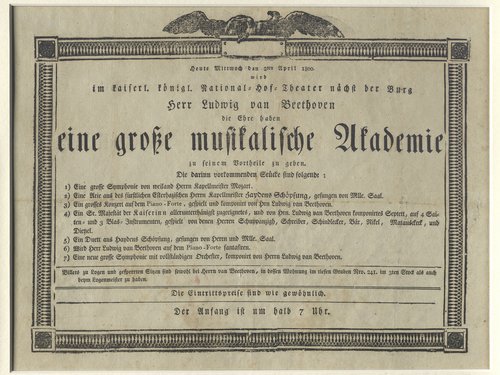
»The symphony would benefit immensely (it lasts a full hour) if Beethoven were to decide to shorten it and bring more light, clarity and unity to the whole.« The reactions to the first public performance of Beethoven’s Third Symphony on 7 April 1805 at the Theater an der Wien reveal a lack of understanding. Never before had there been a symphony of such proportions.
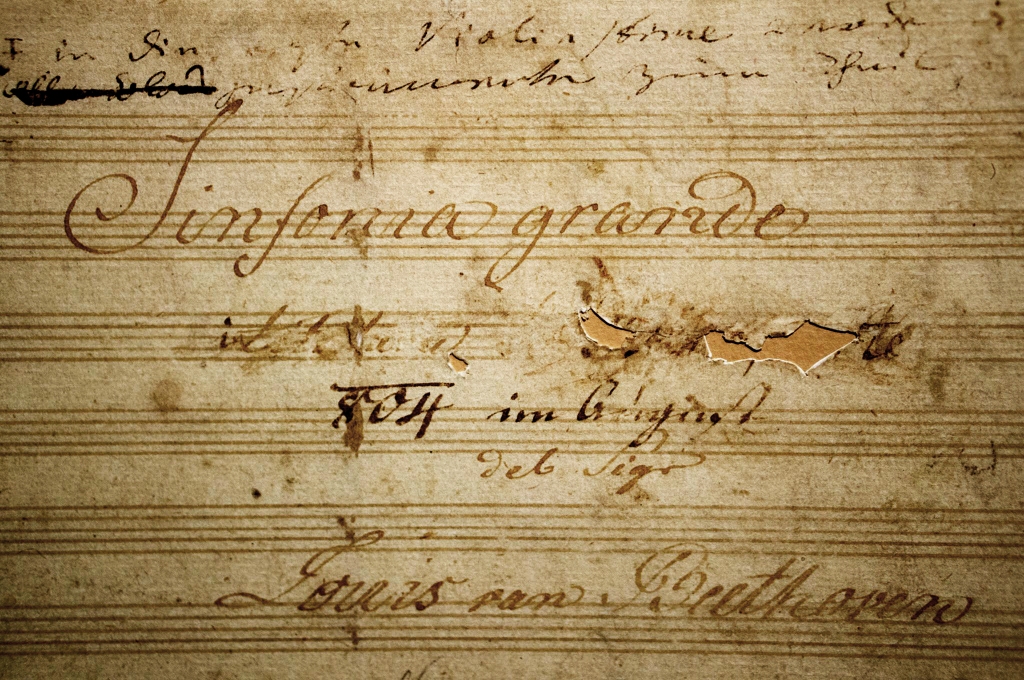
The »Eroica« is also famous for the convoluted story behind its dedication. Initially, Beethoven planned a piece of music in homage to Napoleon, whom he first admired and then came to despise. At first, he wanted to dedicate his symphony to the commander. But when Napoleon crowned himself emperor, Beethoven is said to have raged, saying: »He is nothing more than an ordinary man! Now he will trample all human rights underfoot, merely to indulge his ambition; he will now set himself above everyone else and become a tyrant!«
This led to what is perhaps the most famous blunder in music history: Beethoven scraped out the supposed dedication from the title page. In the first London score of 1809, the focus then shifted to an unknown hero: »Sinfonia Eroica composta per celebrare la morte d’un Eroe« or, later, »per festeggiare il sovvenire di un grand’uomo«.
I. Movement
Allegro con brioLet’s suppose, for a moment, that Beethoven had begun his Third Symphony directly with the main theme, played solely by the strings. That would sound unassuming and lyrical, almost idyllic.
Yet Beethoven precedes this theme with something that has a jarring effect. Two bone-dry chords with the force of lightning. As if he were seeking to sever an imaginary Gordian knot with two blows. In any case, with these two chords he shatters everything familiar, everything courtly and polite. It is hard to believe that the lyrical main theme will emerge from this abrupt, signal-like opening.
But this theme is not merely song-like in character. Richly orchestrated, with the inclusion of timpani and brass, it takes on a majestic, indeed ›heroic‹, character.
A sharp contrast characterises the rest of the first movement. No wonder his contemporaries found it confusing, jarring and bizarre – terms that are still familiar to us today when dealing with contemporary music. Can we really blame Beethoven’s first listeners? There are passages where Beethoven doesn’t just blast us with two chords, as at the beginning, but with a whole series of stark, abrupt notes, enriched with plenty of dissonance.
In the middle section – the development – the tutti beats take on even greater significance. Here, there is no trace of melody or song-like quality. It is a frenzied pounding in what seems like an endless loop, culminating in jarring harmonies.
Much about this first movement is unusual. Take the time signature, for instance. Beethoven chooses an odd three-four time, whereas the opening movement of a symphony is usually in an even time signature. It is precisely this, in turn, that allows Beethoven to create the greatest possible contrasts. Despite all its ruggedness, one is easily led to overlook the dance-like, swaying moments. Then the grand symphony transforms into subtle chamber music. Individual instruments pass the baton to one another almost tenderly.
This monumental first movement, which in itself is as long as some of Mozart’s early symphonies in their entirety, ends just as it began: with two beats. Shortly before this, the main theme is heard once more: once again with a further roughening of its rhythm and timbre – which shows that Beethoven often transforms a small thematic cell with such virtuosity that it appears in ever-changing guises.
II. Movement
Marcia funebre (Adagio assai)Beethoven leads us from the majestic E flat major into the sombre C minor. The second movement is a funeral march: Marcia funebre.
The oboe then takes up this sombre theme. Suddenly, it sounds less sombre, more slightly melancholic – or is there perhaps even something comforting about it?
As the piece progresses, however, it is once again the oboe which, blending with the flute, softens the melancholy of the main theme. Is this movement perhaps not quite as pessimistic as the opening bars led us to believe? Suddenly, we find ourselves in C major! So there is reason for hope!
Yet Beethoven returns to the funeral march theme. What is more, he intensifies the action. The horns emerge powerfully, fortissimo. Time and again, Beethoven calls for sforzato – strong accents. Everything builds towards a climax – and culminates in a very brief pause.
The conclusion? Everything seems to be falling apart. Leonard Bernstein, the famous American conductor, once said: »Here, you can literally see the music shattering into fragments.«
III. Movement
Scherzo (Allegro vivace)As early as his first two symphonies, Beethoven had moved away from the courtly minuet as the third movement. The scherzo simply offers him more possibilities that suit him better: the biting quality, the clashing elements, the many bold changes within a very confined space – and, not least, the opportunity to expand the form of the movement.
Allegro vivace: The strings begin sempre pianissimo e staccato (»always softly and short«). Very small steps create a sense of added restlessness. Soon the oboe joins in boldly.
The atmosphere is tense – and what a contrast to the second movement, which began so lacklustre! Here, the tension builds with every bar; one is practically waiting for an explosion. But Beethoven denies us that – at first. Then, however, comes the fortissimo:
The middle section, known as the Trio, opens with three horn parts. Associations with hunting are permitted.
Beethoven then returns to the first section, though not exactly as it was. The movement ends with an Alla breve section, where the tempo seems to quicken. Beethoven gives the impression of an ending, briefly leading us astray, before steering us towards the expected conclusion.
IV. Movement
Finale (Allegro molto – Poco andante – Presto)The finale begins Allegro molto and, as befits the tempo, with great vigour. Whereas Beethoven relies on angular chords in the first movement, he now calls for wildly surging runs of rapid sixteenth notes. This is followed by an abrupt halt: five short chords and one sustained chord.
This movement demonstrates just how closely everything in the entire symphony is interwoven: time and again, rhythmic and melodic elements emerge which, on closer inspection, we recognise from the previous three movements. Finally, the distinctive theme – one we encounter repeatedly throughout Beethoven’s oeuvre – is heard for the first time.
The origin of this theme is the last of the 12 Contredanses, WoO 14. The theme also plays a defining role in the Piano Variations, Op. 35, and in The Creatures of Prometheus. The original dance from this ballet score sounds like this:
In the finale of the »Eroica«, Beethoven breaks down and varies this catchy theme several times. For example, through the flute.
If the flute can do it, so can the oboe. In the oboe’s rendition, however, the theme seems free of all haste, as if in slow motion.
This movement contains fugue-like sections, accelerations, intensifications and decelerations. The finale is over 400 bars long. It is half a study in counterpoint, half a free fantasy, at times folksy, at times pastoral, at times intimate, at times pompous. But then Beethoven leads the music into a strange state of limbo. A cliffhanger with an open ending. How might this end?
Is Beethoven trying to lull us to sleep? That wouldn’t be in keeping with such a grandly conceived symphony. After all, the coda – the final section – rains down on the audience. 31 bars at Presto. A frenzy! The »Eroica« concludes stormily and with a strong fanfare-like quality: heroic, indeed.
Beethoven’s Third at the Festival
 , Beethovenhalle, Great Hall
Kit Armstrong & Le Concert Olympique III
Orchestra, PianoIlya Gringolts, Christian Poltéra, Jan Caeyers
Bach, Beethoven
We would like to thank Arion for granting us permission to use excerpts from Jan Caeyers’ recording of Symphony No. 3.
Copyright: Beethoven Akademie, Jan Caeyers: Beethoven: Symphonies No. 3 & No. 1, Vol. 2 (Arion 2011)