• Programme & Tickets
  • Beethoven Spring
  • Magazine
  1. Magazine

Listening Guide

»Missa Solemnis«

    • #Beethoven
    • #read
    • #listen
Link was copied to your clipboard
Beethoven: Letter to B. Schott's Söhne, 10 March 1824 © Beethoven-Haus Bonn, NE 295

Beethoven’s great mass is a complex and mysterious work – all the more reason to listen carefully! Bennet Eicke, conductor and musicologist, shows us the details of the »Missa« and guides us through Beethoven’s sonorous confession of faith with his favourite moments.

The audio samples are from the rights-free recording with Arturo Toscanini, the Robert Shaw Chorale and the NBC Symphony Orchestra from 1953. The concert at Beethovenfest with Early music ensemble B’Rock and René Jacobs will certainly have a different, much leaner sound – the performance tradition of Beethoven’s music changes over time.
Credo?

If letters could sing ...

Beethoven was not the first composer to write a mass, nor will he be the last. It is therefore all the more impressive that his »Missa Solemnis« gives the impression that he has said everything there is to say in the liturgical texts of Kyrie, Gloria, Credo, Sanctus, Benedictus and Agnus Dei – and celebrates every moment with all his soul.

The magic of the piece lies above all between the notes – each transition to new music creates expectation, anticipation. This merging into a great unity always succeeds with a view to the players – orchestra, soloists and choir interact with each other in the most diverse ways, the charm lies in the versatility and their harmonisation with the moment and the text. Beethoven uses form and character to build individual parts of a cathedral that give the music breadth and depth, but also unity and intimacy.

Kyrie

In the Kyrie, the character of the space immediately presents itself – mercy is not demanded with force and pressure, but with modesty in a soft, gentle sound in which the orchestra and choir pass the balls to each other.

Structurally, the »Christe eleison« (»Christ have mercy«) is a classical middle section that belongs above all to the soloists – but is so smoothly integrated into the main section in terms of tempo and sound that everything comes together as a whole.

Gloria

The music begins to speak in the Gloria: From a solemn rumble with timpani and trumpets, the »Gloria in excelsis Deo« (»Glory to God in the highest«) breaks in – and leads in the further course through a wide variety of changes to a clear pronunciation of the text. 

A textbook is worthwhile – every nuance of the mass text is interpreted: »Et in terra pax« (»And peace on earth«) shows peaceful, quiet phrases, »Laudamus te« (»We praise you«) as a monophonic exclamation of the choir, which finds contrast in the intimate »Adoramus te« (»We worship you«) at a very short distance.

The obstacles that are overcome here are also incredible – in the transition from section to section, new sounds are constantly being broken up. However, it is classic that there is a grand fugue at the end of the movement – but not so classic that the ending feels very open due to a plagal cadence, i.e. a closing, yet less stringent chord sequence.

Credo

Like the Gloria before it, the Credo is very text-related. What is new, however, is how the Credo reveals itself in its sections as a dramatic process, at the end of which we suddenly perceive the recurring »Credo« as a confirmation of faith in a completely different way than at the beginning of the movement – in memory of all the things we have experienced up to this point.

It is all the more fitting that the Credo fades away nobly with the »Amen« instead of bursting out triumphantly.

The choir is also exciting here – where does the choir sing together, where are the individual voices in dialogue with each other? All these aspects are always related to the interpretation of the text in the moment, between what is illustrated and what is felt.

Sanctus

In the Sanctus, Beethoven’s instruction to play the Kyrie »with devotion« once again comes to the fore. In the subsequent intimate prelude to the second part of the movement, the Benedictus, Beethoven opens up a new space – one has the feeling of entering a remote, quiet chamber. A violin solo, symbolising the Holy Spirit, breaks open the whole of heaven in its tenderness. The choir contributes text interjections while the soloists play out the music.

Agnus Dei

In the concluding Agnus Dei, the opera then breaks in, the characterisation of the »Lamb of God« begins like a funeral march, which repeatedly finds rays of hope in the intermediate sections (»pacem«, »peace«).

There is a dramatic passage where we have stylistically arrived at a recitative and the full force of the moment makes the subsequent resolution all the more powerful.

And here, too, it is the quiet moments that seem like the loudest. The piece ends as it began – with devotion. There is no great drama, but rather the peace that Beethoven has found, which he bleeds directly onto the paper as if from his own soul. In the end, there is a work here that is greater than any religion, because Beethoven speaks from the heart what resounds far beyond any letter.

The Missa live at the festival

Thu. 25.3.2027
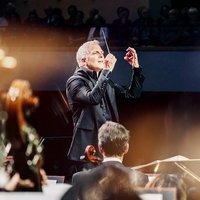
  • A conductor leads an orchestra, surrounded by soft light, while musicians play with focus and intensity.
    19:30, Beethovenhalle, Great Hall

    Missa solemnis

    Orchestra, Vocal

    Beethoven Orchester Bonn, WDR Rundfunkchor Köln, Chor des Bayerischen Rundfunks

    Beethoven

    Sold Out
Article by Bennet Eicke
Ticket Hotline +49 228 2010344 Mon, Wed–Fri, 10:00–14:00
Subscribe to Newsletter
  • Barrier-free access
  • Contact
  • Press
  • Newsletter
  • Team
  • Jobs
  • Calls for Submissions
  • Festival archive
  • CO₂-Compensation
  • Imprint, terms & conditions, privacy
  • Declaration of compliance
  • Cookie settings
  • Deutsche Post DHL Group
  • Telekom
  • Sparkasse KölnBonn
  • Deutsch Welle
  • Stadt City Ville Bonn