How does a composer in Vienna, on the cusp of the 19th century, best present himself to the musical public? How does one demonstrate one’s musical abilities in the most compelling way? The symphony is regarded as the ideal form for this and, ideally, as a stepping stone to success. On 2 April 1800, Ludwig van Beethoven conducted his First Symphony at the »K.K. Hoftheater nächst der Burg«. At Beethovenfest 2026, the work will be performed by Le Concert Olympique under the baton of the Belgian conductor and musicologist Jan Caeyers. Music journalist Christoph Vratz presents Beethoven’s First Symphony in the Listening Guide.
Listening Guide
Beethoven: Symphony No. 1
A shake-up founded on tradition
In keeping with the ›classical‹ era, a symphony follows certain external rules. Its external parameters are largely predetermined. The first movement is supposed to be longer than the subsequent movements. The internal structure is also predetermined. The first movement is based on the sonata form, comprising the following sections: exposition (presentation of the themes), development (elaboration of the themes), recapitulation (analogue of the first section) and coda (an independent concluding section).
The formal scope within a symphony is therefore limited. Yet it is precisely this scope that must be utilised. This is particularly true for an innovator such as Beethoven. His inner drive towards an individual, freely shaped art is strong. Regularity as much as necessary, individuality as much as possible – that could be his motto.
Beethoven had by now been in Vienna, the capital of the Habsburg Empire, for several years. With its 250,000 inhabitants, however, Vienna was considerably smaller than Paris and London. Having come from Bonn, Beethoven purposefully continued his training in his new home, for example as a pupil of Joseph Haydn. He soon caused a sensation, particularly as a pianist with a magnificent talent for improvisation. In 1795, he presented himself to the Viennese public for the first time with a piano concerto of his own composition; he had also already composed sonatas and chamber music. What was still missing was a symphony.
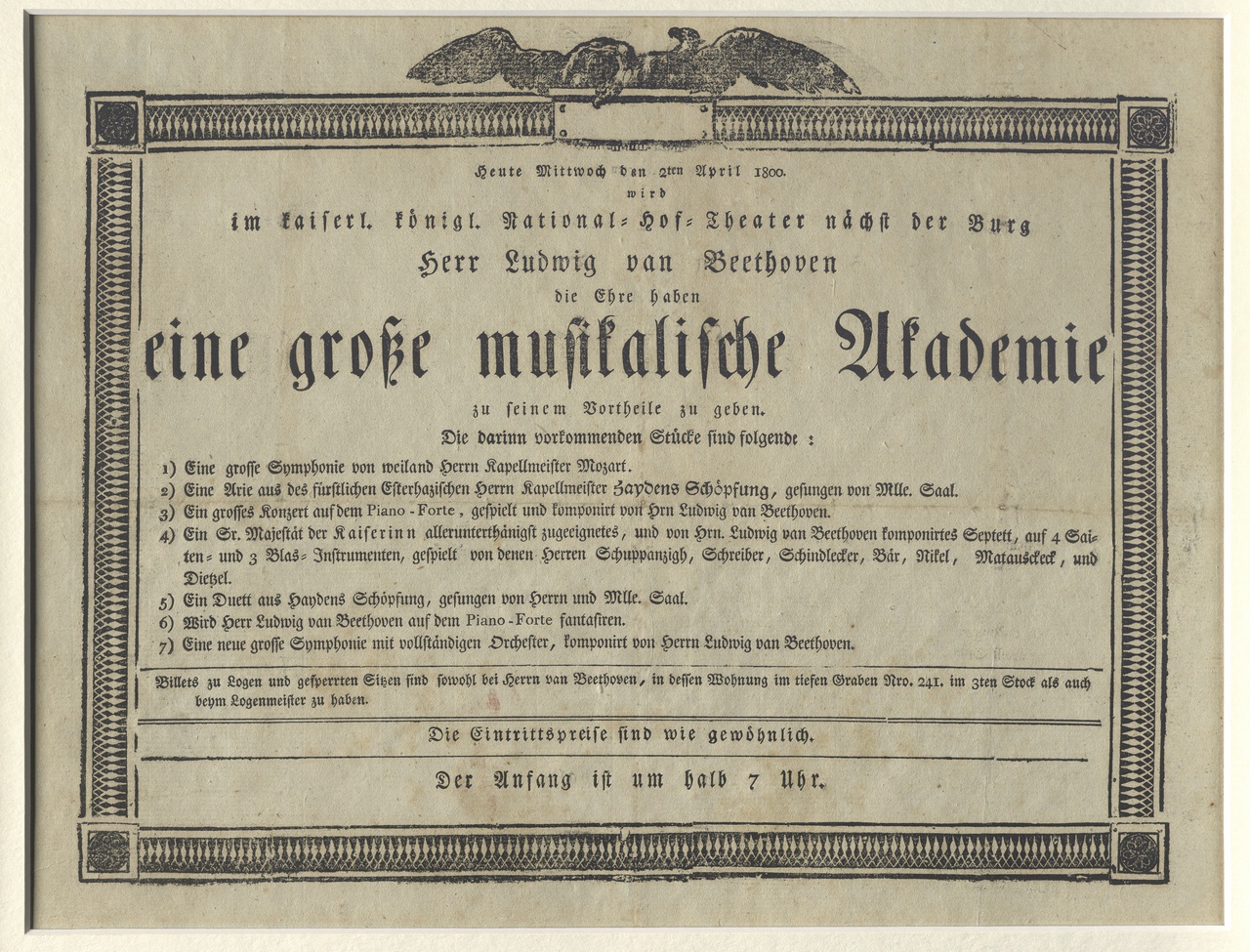
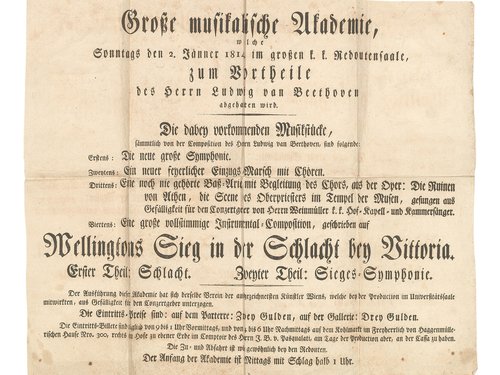
Beethoven announced »a grand musical academy« for 2 April 1800, as can be read on the theatre programmes (see title image). An Akademie refers to a concert event featuring one or more artists, organised at the organiser’s own expense. This is Beethoven’s first Akademie. He is taking a risk with it, not least financially. Yet now he wishes to showcase himself to everyone – not just anywhere, but at the Hoftheater, Vienna’s premier musical venue.
The programme includes, amongst other works, a piano concerto (op. 15), a chamber music piece (Septet, op. 20) and, as the seventh item, a »new grand symphony with a full orchestra, composed by Mr Ludwig van Beethoven«.
I. Movement
Adagio molto – Allegro con brioEven in the opening bars, Adagio molto, Beethoven the symphonist reveals himself to be a radical innovator: the opening, with its harmonic interplay in the first chords, identifies the composer – then just under 30 years old – as a non-conformist. Six years after the premiere, the writer for the Berlinische Musikalische Zeitung still described this introduction as an »indeterminate, albeit ingenious, beginning«.
What makes this introduction so special is that Beethoven not only takes great harmonic risks here, but also incorporates all the elements of orchestral composition. The orchestral sections are, as it were, set against one another – on the one hand, long wind melodies; on the other, the short, plucked pizzicato responses of the strings. A real wake-up call for the Viennese audience.
A nuanced dynamic treatment further heightens the overall build-up of tension in the slow introduction. It could scarcely be more expressive. Beethoven counters all expectations of the familiar with a clear aesthetic statement: this music is different; it is new. This also applies to the transition to the Allegro con brio, the fast section of the first movement.
The instrumentation and ensemble are by no means revolutionary; here, Beethoven still follows the tradition of Haydn and, above all, Mozart. What sets him apart, however, is what he does with the available instruments – for instance, his use of contrasts. This is already evident in the abrupt transition to the lyrical second theme, characterised by the flute and oboe. The theme has the feel of an Ecossaise. A dance-like motif to counterbalance the stirring accents of the first tutti theme!
The development section already reveals Beethoven’s later-refined ability to draw out the maximum possible variety from compact material. Contradictions and resolutions, questions and answers follow one after the other.
The movement ends just as startlingly as it began. The coda culminates in five full-bodied chords.
II. Movement
Andante cantabile con moto»Andante«, meaning »at a walking pace«, is the instruction. But that is not enough for Beethoven; he modifies the indication further by adding »cantabile« – »song-like« – and »con moto« – »with movement«. So this is anything but a restrained, leisurely stroll. Once again, Beethoven tackles the tradition without false respect. The slow movement transforms into music that comes across as a stylised minuet.
Beethoven develops the thematic material through minor-key nuances, pulsating rhythmic figures and bold dissonances. In some places, one might think that Franz Schubert had already been looking over Beethoven’s shoulder here and drawing inspiration from his art of orchestration.
But that is not all: Beethoven interweaves the parts in a fugue-like manner. In Beethoven’s later works, this integration of fugue elements would become even more central.
III. Movement
Menuetto (Allegro molto e vivace)Third in a symphony, as tradition would have it, usually comes a minuet, an old courtly dance movement. Whilst Haydn had already experimented with the structural forms of the minuet, and Mozart, too, left no stone unturned, with Beethoven one wonders: is he merely using the term ›minuet‹ as a formality? Far more telling is what he actually writes: »Allegro molto e vivace«. This fast tempo marking alone suggests that the days of the moderately brisk ballroom dance are over. It is almost a proper scherzo in its own right, sweeping away all traces of courtly convention.
Within seconds, the music fluctuates between very soft and loud. Beethoven seems to manage without a proper theme, instead working with many jarring changes. The timpani prove to be a constant driving force.
Even the trio – as the middle section of a minuet is called – is by no means, as one might expect, a lyrical oasis. The strings provide an almost ghostly accompaniment to the melodic line of the woodwinds.
IV. Movement
Adagio – Allegro molto e vivaceLike the first movement, the finale is structured in sonata form. It is preceded by an Adagio, a slow introduction: featuring a three-note motif which is repeated several times, each time expanded by a further note. One can hear a scale taking shape, until, on the sixth repetition, the Allegro molto e vivace begins – a designation we are already familiar with from the third movement.
Although Beethoven does not specify »con brio« here, as he does in the first movement, this movement certainly sounds fiery. The tension builds, then suddenly an unexpected turn of events occurs, and the tension must build up again. Yet, in typical Beethoven fashion, everything happens in rapid succession, in an economically compact manner. At the end, in the finest chamber-music style, he once again brings the woodwinds to the fore as soloists, before the symphony ends almost abruptly in a tutti.
Anyone who thinks that Beethoven, in his First Symphony, was still composing like a beginner – uncertain and not yet entirely clear about what he wanted – is terribly mistaken! No wonder that reactions at the Akademie to the world premiere of his new symphony were mixed: a blend of approval and surprise:
»At the end, a symphony of his own composition was performed, in which there was a great deal of artistry, innovation and a wealth of ideas; only the wind instruments were used far too much, so that it was more harmony than full orchestral music.«
– Allgemeine musikalische Zeitung 1800
The Symphony No. 1 at the festival
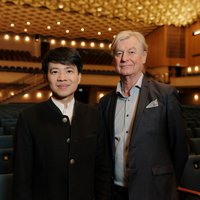 , Beethovenhalle, Great Hall
Kit Armstrong & Le Concert Olympique I
Orchestra, PianoJan Caeyers
Bach, Beethoven
We would like to thank Arion for granting us permission to use excerpts from Jan Caeyers’ recording of Symphony No. 1.
Copyright: Beethoven Akademie, Jan Caeyers: Beethoven: Symphonies No. 3 & No. 1, Vol. 2 (Arion 2011)