• Programme & Tickets
  • Beethoven Spring
  • Magazine
  1. Magazine

5 Questions for ...

Jakob Nierenz of the Rothko String Quartet

    • #read
    • #Interview
Link was copied to your clipboard
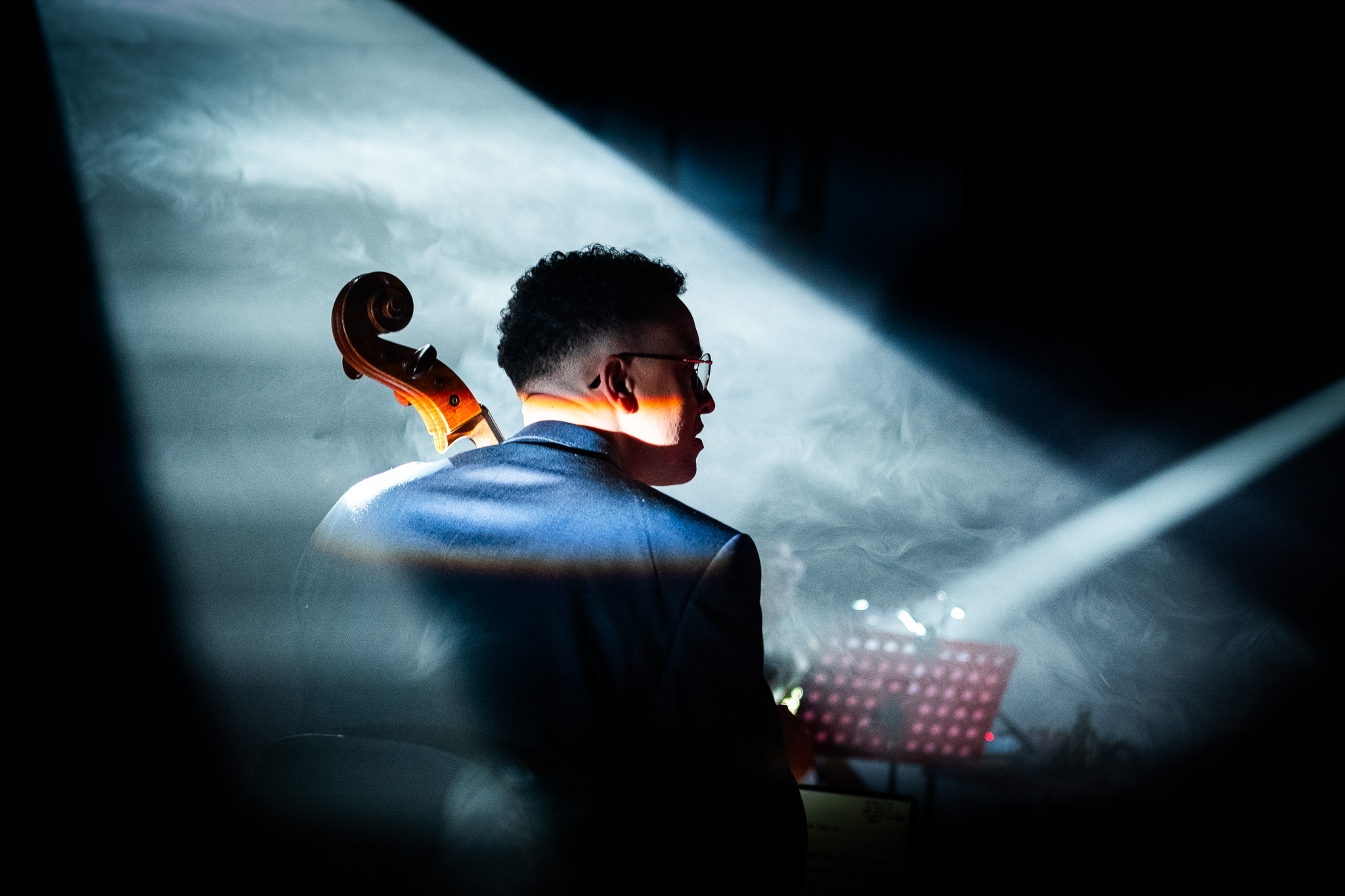
A man is playing a cello in a concert. His back is to the camera and he is facing off to the side so his face is in profile.
Jakob Nierenz © Beethovenfest Bonn

On their constant search for a fresh repertoire, the Rothko String Quartet has compiled a programme with contents that span epochs and styles. The four musicians, who are close friends, might work rather unconventionally for a quartet. It is precisely for this reason, though – through common and, in particular, differing musical points of interest – that they find new and interesting projects time and time again. Whether Joseph Bologne Chevalier de Saint-Georges or Jessie Montgomery: We talked about the personal cause of breaking open the established musical canon and acknowledging the music of Black composers with cellist Jakob Nierenz.

As a cellist, one can mostly hear you in ensembles – and with very different projects, one time in the Rothko Quartet, another time with the ensemble reflektor or the diversely composed Chineke! Orchestra. Why not a solo evening? What do you like about working in a quartet?

I never was the type for being a soloist. For me it is nice to be in a room where everybody contributes something and adds their own thing. It feels best communally and, in the end, music is something very communal. Getting to know people through music: That is what I love – and that it works with instruments that do not come from our tradition as well. In our quartet, I can entirely run free. We four get along so well because we have known each other for so long, and because our tastes have many overlaps.

Your string quartet moves outside of the normal, expectable tracks. How did that happen?

When we startet with the Rothko String Quartet, 10 years ago, one violinist specialised in New Music, the other in Early Music – and our violist Marc and I always played a lot of different music, with a special interest in improvisation. But because of this we are very good at switching styles quickly. We can play romantic phrases and then, in the next piece, very strenuous minimal music, which feels very different physically. For us, part of it is to be informed: about New Music, extended technique and the traditional string quartet school.
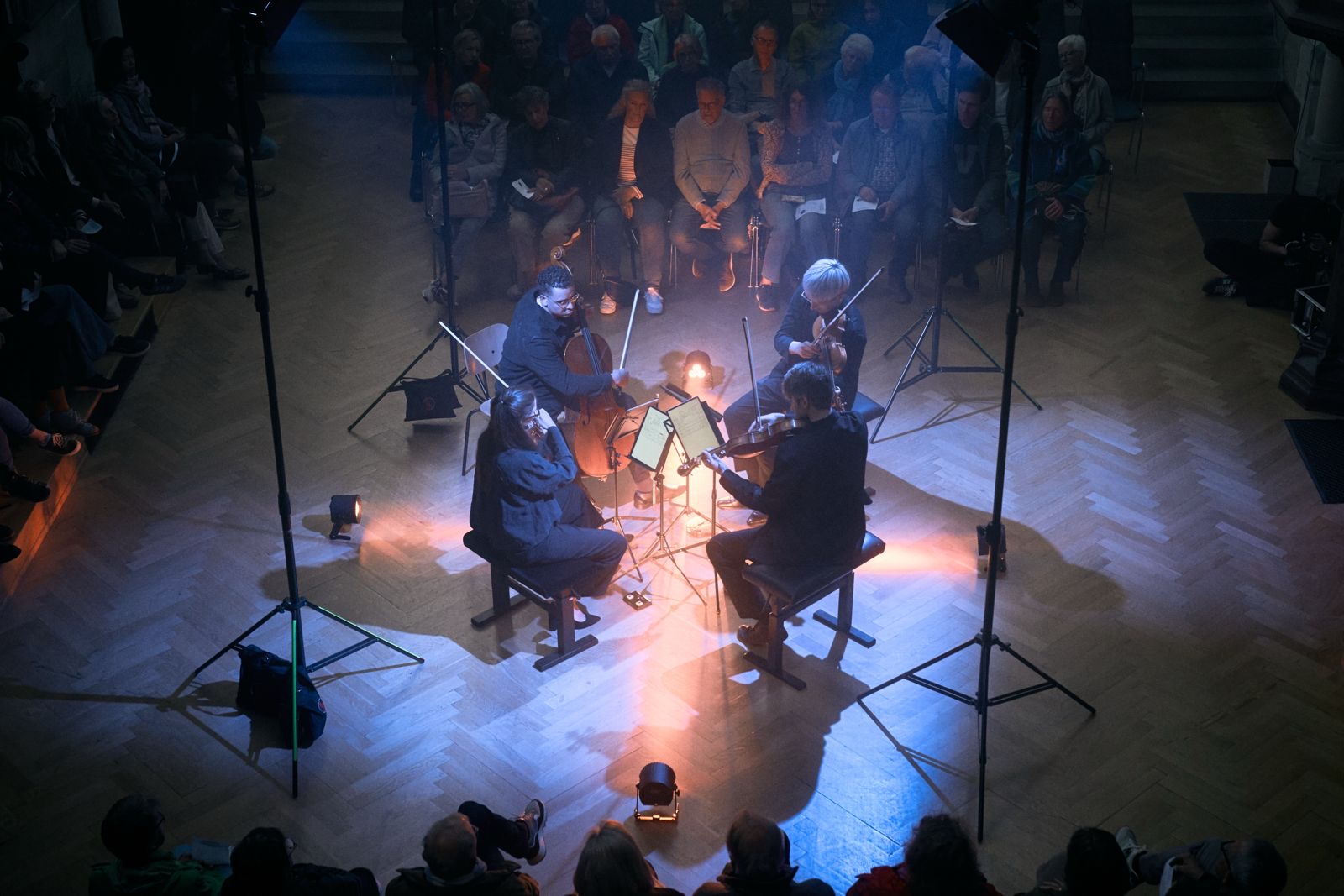
A string quartet performs in a dimly lit room, surrounded by an audience. Moody lights illuminate the musicians from above.
Rothko String Quartet © Diana Lim

But your life is not only the Rothko String Quartet, you are not a traditionally standing quartet. What consequences does this have on your method?

Of course we work differently than a quartet which plays together 100% of the time. We don’t exclusively rehearse with each other. That is why our path is generally different and slower.

But it was clear to us from the beginning that we did not only want to be in a quartet. And I would say: Precisely because we all do different things we always enter joint projects with much inspiration. We want to try new things, then, that we discovered somewhere else. Or to readjust our perspective.

At the founding the starting question was: Why are we needed? The broadening of the repertoire is an important reason of existence for us, because we found how much music has been written for our instrumentation and is not being played until today. Especially with Black composers, looking for what is there to discover is a personal cause. Apart from that, we constantly grow as a group – our project is intended to last for a while, also because we are close friends. We also founded the ensemble reflektor together. The work of many years has been fruitful in different ways. That we are allowed today to play such a programme at the Beethovenfest as a quartet has been a dream from the beginning. 

Um Spotify Inhalte zu laden, akzeptieren Sie bitte Spotify als externe Quelle in den Cookie-Einstellungen Accept

Tell us something about the pieces you curated for the Beethovenfest.

First of all, there is the quartet by Joseph Bologne Chevalier de Saint-Georges. The byname »Black Mozart« is completely misleading: On the contrary, Mozart was inspired by him, for example by his violin concerts through which he was known and innovative as a virtuoso. He was incredibly famous at the time, but today only Mozart’s name is left.

The music of Florence Price can seem incredibly dense. Moving transparently in this maze and still being able to hear everything is very challenging. Especially because there are barely any examples from other recordings of this repertoire. But the aural result is amazing, lush, so to say, colourful, maybe something between Wagner and Debussy, but still unique.

With Eleanor Alberga, the compositional level is simply overwhelming. Her score is especially impressive – everything sounds open, incredible resonance and emotion is being created.

Jessie Montgomery’s quartet shaped us very much as an ensemble, we have had it in our repertoire for many years already. She is a composer of our generation from the USA and brings a counter-proposal to the overly intellectual European New Music.

And Coleridge-Taylor Perkinson writes about the same spiritual as Florence Price, »Calvary«. With all five composers, one feels the connection to their identity, to elements of non-European music, to music of the African diaspora.

Did the concert of 2026 feel a bit like coming home to you? Last year, you were a Fellow with the Beethovenfest.

Yes, I am coming home in a way. I really like the team and I think the programme is wonderful. And how Steven Walter changed the festival so that it is now a place where this is being accepted so readily. Last year, the festival did a lot for me as a Fellow. I felt so much trust in what we are doing, as well as in my debut as a composer. I am very glad that I can do something with the quartet this year, too, that is close to my heart. That is why I am glad to come back to Bonn.

Jakob Nierenz beim Festival

Tue. 22.9.2026
  • A string quartet performs in a dimly lit room, surrounded by an audience. Moody lights illuminate the musicians from above.
    19:30, Beethoven-Haus Bonn

    Rothko String Quartet

    Chamber Music

    Price, Perkinson, Montgomery

Article by Julia Grabe
Ticket Hotline +49 228 2010344 Mon, Wed–Fri, 10:00–14:00
Subscribe to Newsletter
  • Barrier-free access
  • Contact
  • Press
  • Newsletter
  • Team
  • Jobs
  • Calls for Submissions
  • Festival archive
  • CO₂-Compensation
  • Imprint, terms & conditions, privacy
  • Declaration of compliance
  • Cookie settings
  • Deutsche Post DHL Group
  • Telekom
  • Sparkasse KölnBonn
  • Deutsch Welle
  • Stadt City Ville Bonn