• Programme & Tickets
  • Beethoven Spring
  • Magazine
  1. Magazine

Photo Workshop at Beethovenfest

Capturing Sound with a Camera

    • #read
    • #Bonn
    • #Interview
Link was copied to your clipboard
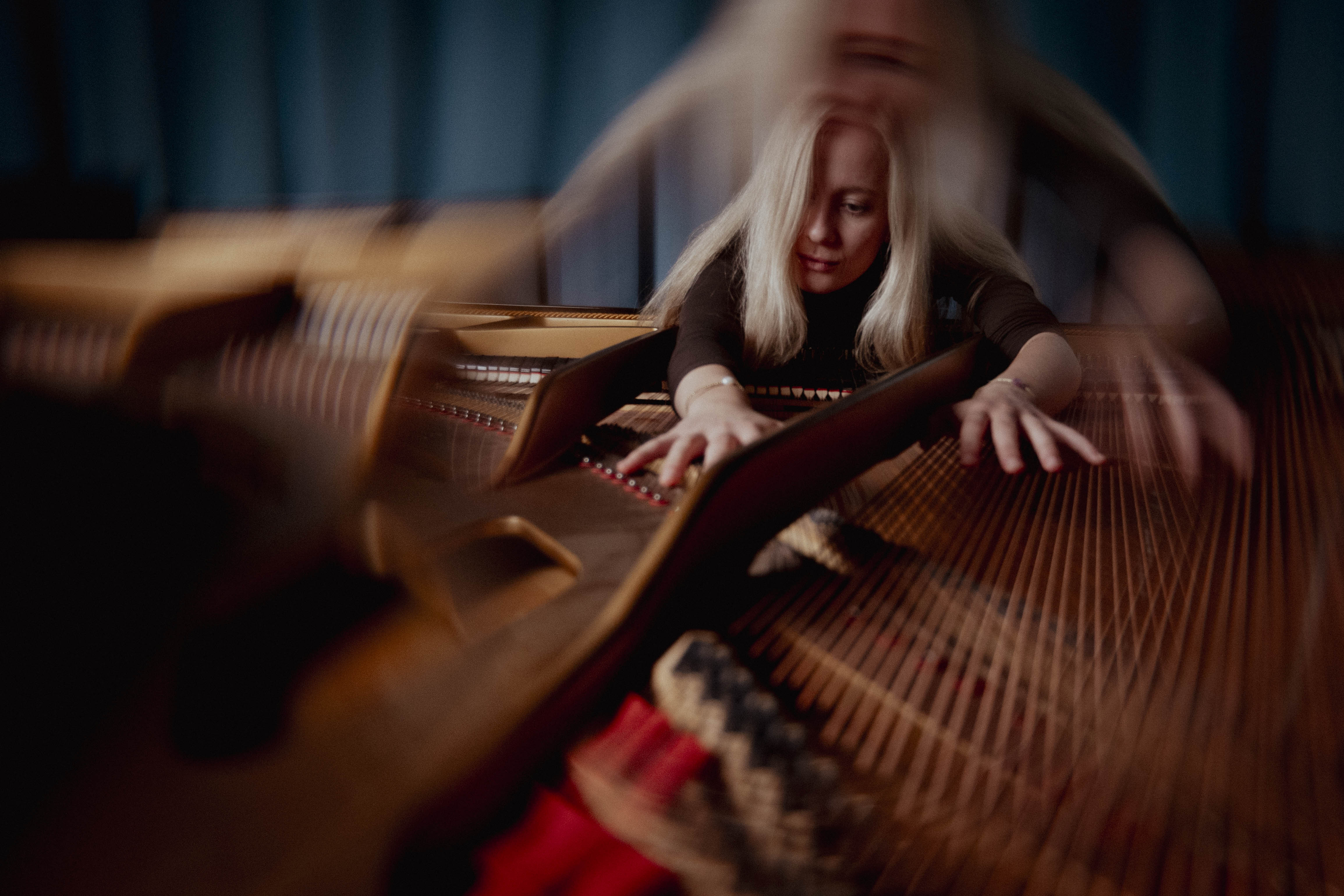
A woman plays the inside strings of a grand piano. The scene is artistically blurred, capturing dynamic motion.
Anna Gebhardt: Portrait from the photography workshop at Hardtberg High School, September 2026 © Lucie Schulze, Jonas Gladbach, students of Hardtberg-Gymnasium Bonn

At the Hardtberg-Gymnasium in Bonn, two musicians and photographers ran a workshop for upper-school pupils – featuring experimental photographic techniques and artists from the Beethovenfest as models. Art teacher Helena Haß reports on two creative days blending photographic art and music.

How did the workshop come about in your class?

I have been teaching art and geography at the Hardtberg Gymnasium in Bonn since the start of the 2026 school year. In September, two of my senior school introductory art classes were able to take part in a two-day photography workshop organised by the Beethovenfest. Before I moved to the school, a fellow art teacher – who is also a musician – had championed this opportunity. The previous art class had already benefited from the photography workshop last year.

Did the workshop tie in with other topics in the curriculum?

Media art is an integral part of the art curriculum, and the list of artists selected for the central Abitur examinations often includes a photographer. In lessons, alongside the analysis of artistic photographs, we carry out tutorials and exercises to introduce pupils to the medium of photography. What was exciting about the Beethovenfest’s workshop programme was the interdisciplinary approach in conjunction with music. Furthermore, I think it’s important to familiarise pupils with the Beethovenfest as an institution within Bonn’s cultural landscape – Beethoven is simply part of the city in which they are growing up and taking their A-levels.

  • An artistic blurred photo of a park with trees and green grass, partially distorted by light and color effects.
  • A skeleton against a vibrant red and black background, creating a dramatic and mysterious atmosphere.
  • A double-exposure image featuring a person with long blonde hair. The blur gives the photo a surreal effect.
  • A tree is reflected in the curved surface of a glass object, surrounded by blurred blue and green tones with shimmering effects.

And how did the workshop tie in with the Beethovenfest?

The idea came largely from Julia Klein, a member of the Beethovenfest’s music education team – she also accompanied us. To bring photography and music together, the two musician-photographers Lucie Schulze and Jonas Gladbach were there to lead the workshop. This year, the workshop was linked to the festival’s recital »Irgendwo auf der Welt« (»Somewhere in the World«), featuring baritone Jonas Müller and pianist Anna Gebhardt, both of whom also contributed to our workshop. Some of the pupils were able to attend their concert at the Beethoven-Haus.

  • A pair of elegant, shiny high heels rests in a corner on a tiled floor. Black-and-white photograph, simple and stylish.
  • Multiple golden brass instruments reflecting off a glass surface, surrounded by green foliage, creating an artistic composition.
  • A dramatically red sky over a scene with trees and a structure, casting shadows on the right.
  • An abstract art photograph showing green vegetation encapsulated within a transparent, geometric object with blurred edges.

How did you go about adopting an artistic approach to photography?

The workshop took place over two days. It began with a conceptual introduction: everyone was asked to choose their favourite photo from their smartphone gallery and then quietly reflect on why it was their favourite. After discussing this, the group listened to a five-minute recording of a piece of music by Gustav Mahler. The task was to capture the auditory impressions and any visual images triggered by the music in a few keywords. There was also a group discussion about this.

And then it was time to get out the cameras?

Exactly. The two photographers had brought along some props from which the young people could choose freely: these included glass prisms, a large glass cube, a glass bowl, colourful Plexiglas sheets in various colours, Vaseline, shards of mirror, heat-sensitive film and stencils. In small groups, they were able to move freely around the school building and take photographs by holding these items in front of their smartphone lenses. The weather was lovely that day, with bright sunshine – light is, after all, absolutely vital for photography. This meant they could take photos not only in the corridors, but also in the school garden and in the school playground. The pupils quickly got into the spirit of experimental exploration. Even with smartphones, there’s a lot you can do, and you also have the option to check and adjust your shots straight away. The two photographers and I, as an art teacher, offered the occasional tip or perhaps some ideas for subjects along the way. Overall, there was already a great deal of creative work on display on this first day of the workshop, which was, after all, quite free-form.

  • A person wears a black helmet and a plastic cloak, posing with a pink flag that features a portrait.
  • A black and white photo of a person wrapped in a USA flag and foil, standing by stairs in a building.
  • A group of four people, blurred, stands in a circle in a forest. They are casually dressed and appear to be chatting.

Did you feel that the musical introduction had an influence on the photographic work?

Certainly. The inspiration provided by the piece of music directly gave rise to entirely different visual ideas. We also set ourselves a thematic framework linked to the concert programme of the singer Jonas Müller: for his recital, he had chosen the theme »American Dream«, in keeping with music by exiles in the USA. On the second day of the workshop, we also created thematic still lifes featuring objects such as an American flag.

On the second day, Jonas Müller and Anna Gebhardt themselves took part in the workshop. Were there further connections between music and photography on this occasion?

Yes, because the second day began with a concert lasting about an hour given by the two of them at the school, during which they presented parts of their recital on the grand piano and through song. In the discussion that followed, topics emerged that link the stage and photographic art: the baritone spoke about how he deals with emotions, how openly he can allow them to surface in a performance, and where the line between genuine and artificial expression lies. In photographic work, too, one navigates between something genuine and something staged, and one’s own attitude behind the camera is just as crucial as the subject.

Immediately afterwards, the singer and the pianist volunteered to pose as models. The photographer Lucie Schulze spoke about her work as a musician photographer. It is important to her that such photos do not always look like passport photos. That is why she often tries out experimental techniques, which had been practised the day before. The pupils were therefore able to take portrait photographs of real musicians against staged backdrops, using Lucie Schulze’s professional DSLR cameras. There were various lenses available and, of course, the accessories from the previous day. A whole range of different poses and expressions were tried out. It was a brilliant collaboration.

  • People seated in a room while a concert takes place. A piano is in the foreground.
  • A photo shoot in a studio. One person is being photographed against a bright backdrop, while three others observe.
  • A man holds a broken mirror, with his face reflected in it. The image appears contemplative and introspective.
  • A woman in a brown top and blue jeans with a triple exposure effect, against a dark, dramatic background.

That sounds very exciting. Was there a presentation of the results?

The photographs were collected and made available to the group straight away. Some really lovely results came out of it, which we were also able to exhibit at the open day. Following on from that, there’ll be a small series of postcards.

How did you find the pupils’ response?

They really got stuck into experimenting. I got the impression that they tried out a great many things and also made an effort to critically assess and correct their own work. The results showed a wide visual range – quite unusual views of the school grounds, close-ups – a high level of creativity came to the fore, and I rarely had to offer much help. Everyone enjoyed it. It’s just a shame that many couldn’t go to the concert because they’re so busy with activities during the week.

  • Two people are captured in an artistically blurred photo, featuring warm color tones for a dreamlike effect.
  • A man with light hair stands in profile against a green light. The atmosphere is modern and artistic.
  • Abstract image blending dark and light colors, reminiscent of feathers. A face subtly appears through the pattern.
  • Five people in black clothing stand around an open grand piano. The lighting creates a dramatic, mysterious atmosphere.

Did the aim of sparking an interest in the Beethovenfest come to fruition? And what role do such activities play in everyday school life, beyond the classroom?

It was precisely the live performance by the two professional musicians, as well as the detailed introduction, that sparked interest, and the pupils asked lots of questions. Generally speaking, a workshop like this offers the chance to get to know certain career paths a little better. It is also very valuable to be able to choose different ways of working here. Being able to spend extended periods of time together strengthens the sense of community, and the young people are freed, for once, from the rigid structure of the school timetable. I can well imagine running this workshop again in my classes. It is, after all, a very generous offer from the Beethovenfest, free of charge – something that is rather rare among the educational programmes offered by regional museums.

  • A black and white photo shows half a person's face, with a spiral blur effect in the background.
  • Blurred image of a woman reaching over a grand piano's strings, with background lights in blue and red hues.
  • Black and white photo of a person leaning sideways, with a stylish blurred effect. The expression appears contemplative.
  • An abstract image of blurred piano keys and hands. The motion suggests dynamic piano playing in full action.

The concert alongside the workshop at the festival

Tue. 15.9.2026
  • 19:30, Beethoven-Haus Bonn

    Jonas Müller & Anna Gebhardt

    Vocal

    Schubert, Schumann, Eisler

Photography workshop at Hardtberg High School, September 2026 © Lucie Schulze, Jonas Gladbach, students of Hardtberg-Gymnasium Bonn

Do you work at a school and are you interested?

Our music education programme is happy to organise bespoke workshops for your groups. Please get in touch with us! mitmachen@beethovenfest.de
Overview offers for school groups
Article by Avischag Müller
Ticket Hotline +49 228 2010344 Mon, Wed–Fri, 10:00–14:00
Subscribe to Newsletter
  • Barrier-free access
  • Contact
  • Press
  • Newsletter
  • Team
  • Jobs
  • Calls for Submissions
  • Festival archive
  • CO₂-Compensation
  • Imprint, terms & conditions, privacy
  • Declaration of compliance
  • Cookie settings
  • Deutsche Post DHL Group
  • Telekom
  • Sparkasse KölnBonn
  • Deutsch Welle
  • Stadt City Ville Bonn