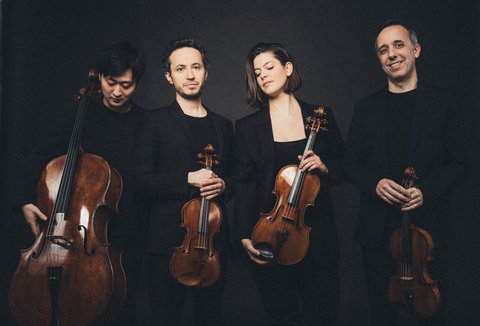
A concert by the Quatuor Ébène is and always will be a musical and sensory experience. For more than two decades, the ensemble has set new standards by bringing a fresh depth to familiar repertoire and engaging in dialogue with the audience.
Following studies with the Quatuor Ysaÿe in Paris, as well as with Gábor Takács, Eberhard Feltz and György Kurtág, came their unprecedented and outstanding victory at the 2004 ARD Music Competition. This marked the beginning of Quatuor Ébène’s rise to prominence, which led to numerous further prizes and awards. For example, in 2005 the quartet was awarded the Belmont Prize by the Forberg-Schneider Foundation, in 2007 it was a laureate of the Borletti-Buitoni Trust, and in 2019 it became the first ensemble to be honoured with the Frankfurt Music Fair Prize.
Alongside the traditional repertoire, the quartet also frequently ventures into other styles, as the New York Times noted back in 2009: »A string quartet that can effortlessly transform itself into a jazz band.« What began in 1999 as a recreational exercise for four young musicians in the university’s rehearsal rooms – improvising on jazz standards and pop songs – became a hallmark of Quatuor Ébène. To date, the quartet has released three albums in these genres: Fiction (2010), Brazil (2014) and Eternal Stories (2017).
Their free-spirited approach to diverse styles creates a tension that enriches every aspect of their artistic work. From the very beginning, this complexity has been enthusiastically received by audiences and critics alike.
The albums by Quatuor Ébène, featuring recordings of works by Bartók, Beethoven, Debussy, Haydn, Fauré and the Mendelssohn siblings, have won numerous awards, including the Gramophone Award, the BBC Music Magazine Award and the Midem Classic Award. In 2015 and 2016, the musicians turned their attention to the art song. They contributed to Philippe Jaroussky’s album Green (Mélodies françaises). For their Schubert album, they collaborated with Matthias Goerne (Lied arrangements for string quartet, baritone and double bass by Raphaël Merlin) and with Gautier Gapuçon (String Quintet in C major, D 956).
Together with Antoine Tamestit, the Quatuor Ébène recorded Mozart’s String Quintets K. 515 & K. 516, which were released in spring 2023. The album has been honoured with awards such as the Choc Classica, Diapason d’Or and Gramophone of the Month.
»The way scents seem to transform into sounds, echoes resound from the depths of the space, and how the four musicians weave their way thoughtfully, only to then seize the moment with fierce intensity and expand with explosive energy – it was intoxicating.« – Süddeutsche Zeitung, March 2023
Foremost among their recordings is the set of Beethoven’s 16 string quartets. Between May 2019 and January 2020, the quartet recorded these in a global project spanning six continents. With this complete recording, the four musicians from France also celebrated their 20th anniversary on stage, which they marked with performances of the complete string quartet cycle in Europe’s major concert halls, such as the Philharmonie de Paris and the Alte Oper Frankfurt. Invitations from Carnegie Hall in New York, the Verbier Festival and the Wiener Konzerthaus were also on the agenda.
In January 2021, the quartet was commissioned by the Munich University of Music and Performing Arts to establish a string quartet class, the newly founded Quatuor Ébène Academy. Since the 21/22 season, the quartet has been presenting a cycle at the Vienna Konzerthaus together with the Belcea Quartet. In the 23/24 season, they were ensemble-in-residence at the Philharmonie Luxembourg and, from 22/23 to 24/25, Quatuor en résidence at Radio France.
The Ébènes will open the Philharmonie de Paris String Quartet Biennale in January 2026, once again together with the Belcea Quartet, and conclude it with John Adams’ Absolute Jest. To mark the 40th anniversary of Suntory Hall, the quartet will present the complete Beethoven string quartet cycle in Tokyo. In addition, the quartet will launch its Beethoven cycles at venues including the Berliner Philharmonie, the Accademia Nazionale di Santa Cecilia in Rome, Wigmore Hall in London and at Beethovenfest Bonn.
Pierre Colombet plays a violin by Antonio Stradivari from 1717, known as the »Piatti«, which has been kindly loaned to him by a generous sponsor through the Beares International Violin Society.
Gabriel Le Magadure plays a violin by Antonio Stradivari from 1710, the »King George«, generously on loan from the Stradivari Foundation Habisreutinger-Huggler-Coray.
Marie Chilemme plays a viola by Antonio Stradivari from 1734, the »Gibson«, also a generous loan from the Habisreutinger-Huggler-Coray Stradivari Foundation.
Yuya Okamoto plays a cello by Antonio Stradivari from 1698, the »De Kermadec-Bläss«, also a generous loan from the Habisreutinger-Huggler-Coray Stradivari Foundation.
Concerts at the festival
 , Kleine Beethovenhalle, Muffendorf
Beethoven String Quartet Cycle I
Chamber MusicQuatuor Ébène
Beethoven