The New York String Quartet performs a flawless rendition of Haydn and then retreats to the study to collaborate with composers on developing new sounds. The up-and-coming ensemble will be visiting Bonn for the first time in September. Here they speak of their approach and the new work by Billy Childs that they have commissioned.
5 Questions for ...
Isidore String Quartet
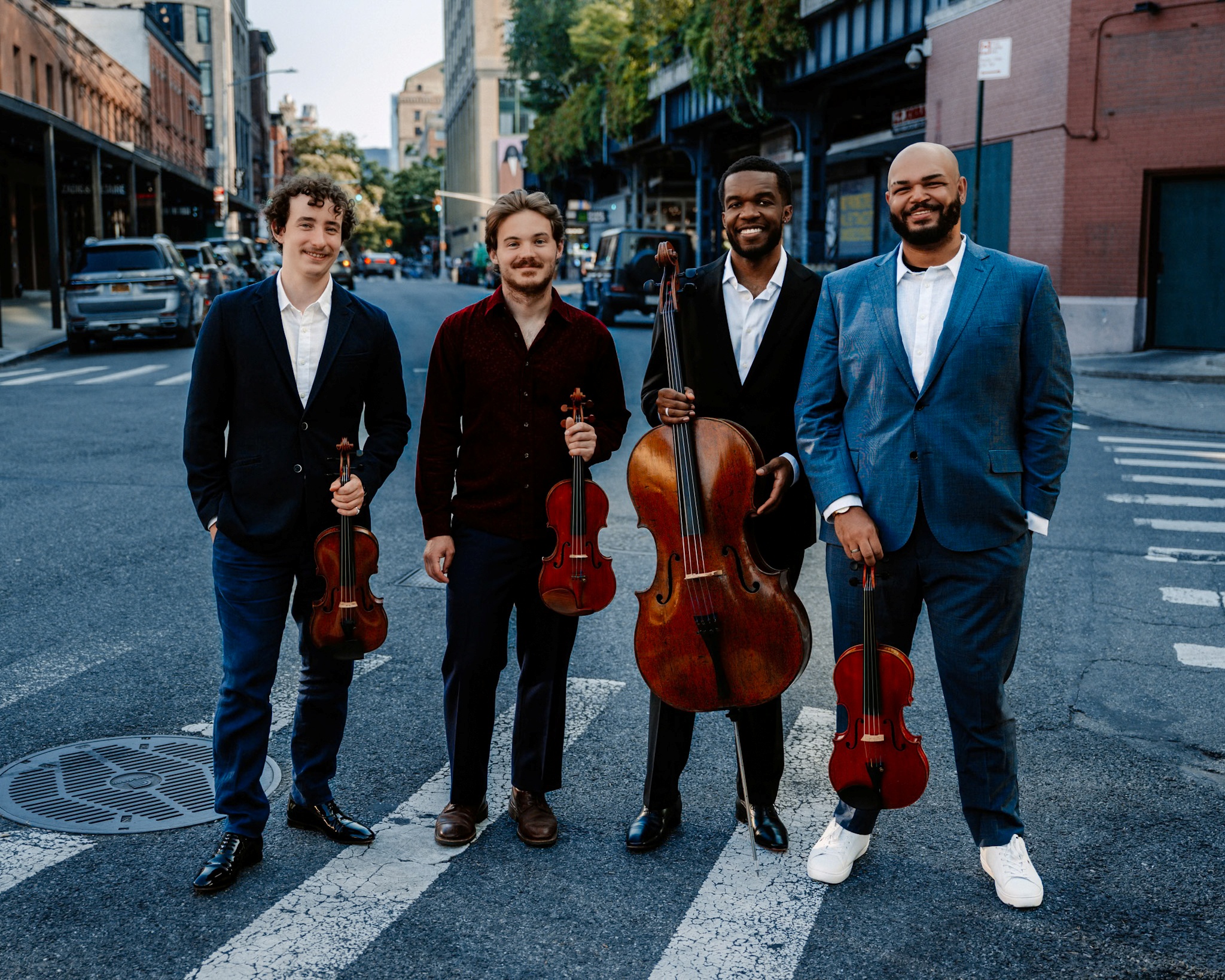
You blend tradition with the present day – this is evident in your concert programme. Is that how you define yourselves as a quartet?
We have always sought to create a dialogue between the established quartet repertoire and the work of living composers. We approach the canonical works as if they are brand new, and new works as if they are already part of the canon – a philosophy we inherited from our mentors in the Juilliard String Quartet. When placed alongside one another, these pieces illuminate and enrich each other. Across centuries, styles, and traditions, they engage in a conversation that unfolds throughout the concert.
Is working closely with the composers also important in this regard?
Yes, very much so. Since the beginning of our time as a quartet, we have felt a deep connection to the music of Billy Childs. After performing his Second and Third String Quartets, we were honoured to commission American Mosaic, his Fourth Quartet. This collaboration brought together Billy's compositional voice and our own artistic perspective, resulting in a work that feels both deeply personal and universally resonant.
What particularly fascinates you about Billy Childs’ new quartet?
Childs possesses a remarkable ability to merge jazz and classical traditions while maintaining a strong sense of narrative. In American Mosaic, the quartet becomes a vehicle for storytelling, with each movement contributing to a larger emotional and social journey. At its core, American Mosaic suggests that meaning arises not from uniformity, but from the interaction of distinct voices – like the individual pieces of a mosaic. Billy Childs captures the complexity of race relations in the United States and expresses a hopeful vision for the future within the span of three movements. As a diverse quartet, it has been especially meaningful for us to collaborate with an African American composer whose artistic voice combines extraordinary musical craftsmanship with a profound social awareness.
Are there any similarities with the music of the evening’s second American composer, Brittany J. Green?
This will be our first encounter with the music of Brittany Green, and we are very much looking forward to exploring her musical language and getting to know her as a composer. In Lead Me Home, Green creates a shimmering sonic landscape that unfolds gradually, drawing listeners into an intimate and ethereal sound world. Both works offer a different perspective on longing, struggle, and ultimately, human resilience.
What happens when you compare today’s American works with those of Mendelssohn and Haydn?
What excites us most about chamber music is its ability to bring many different voices and perspectives into conversation within a single concert. The dialogue between music written centuries apart allows us to explore timeless human experiences through multiple lenses. American Mosaic engages directly with social and political questions that remain deeply relevant today. At the same time, it is also a brilliantly crafted string quartet that belongs naturally alongside Haydn and Mendelssohn.