• Magazine
  1. Magazine

Art made from music and sign poetry

ensemble in transition

    • #read
    • #Portrait
Link was copied to your clipboard
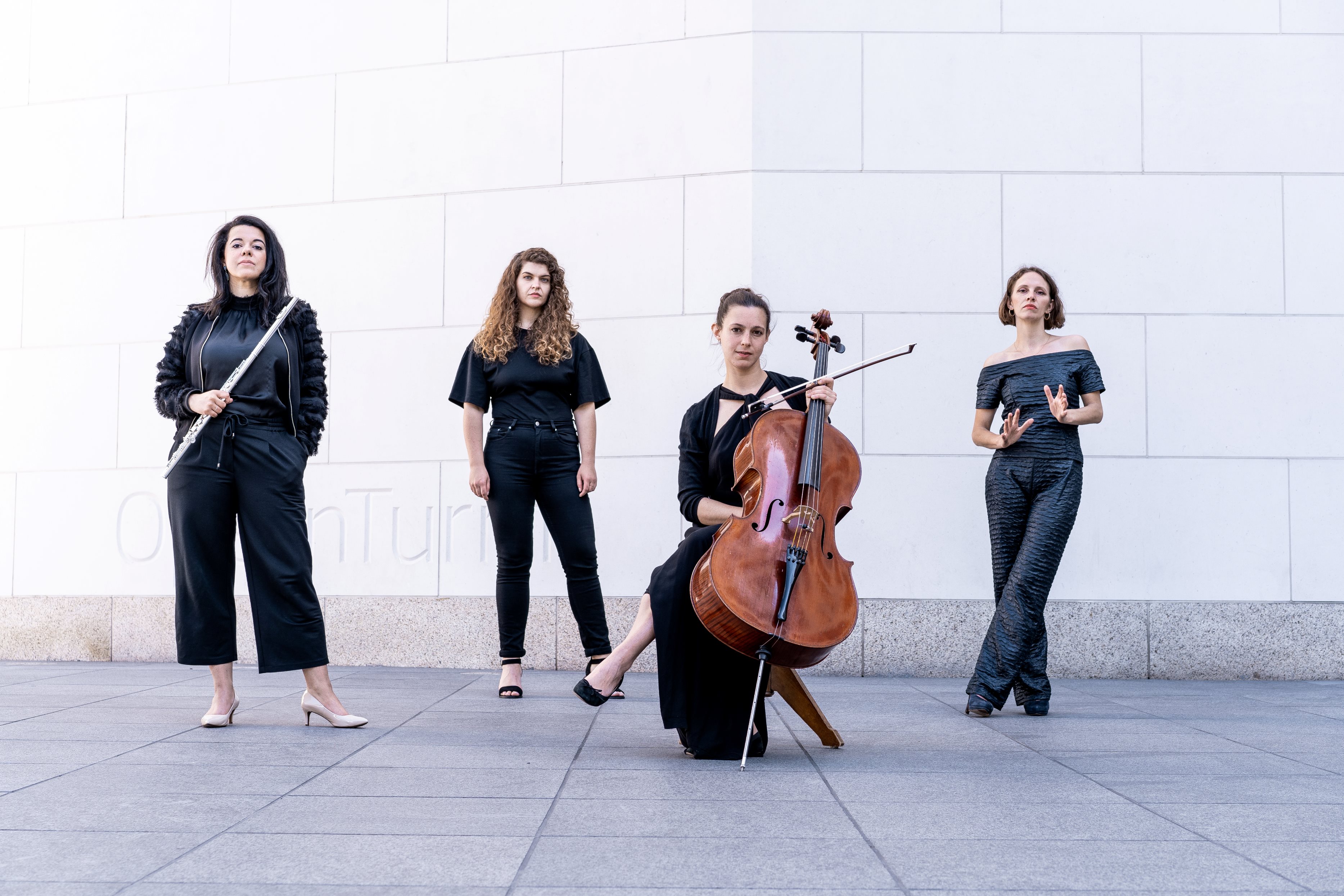
ensemble in transition © Sergej Falk

Locked away in a big house.
Echo infinite.

Learn everything, ignore it.
Forget it.

Sometimes sleep, dreams,
come to mind: I am trapped.

Truly alone?
When will it end?
My house outside?
Better to be awake.

This is a monologue that sign language soloist and dancer Kassandra Wedel notated in sign language grammar for the composition Echo:Reflexion. Sign language and sign language poetry are not usually transcribed. This notation served as a tool for the hearing musicians of ensemble in transition during the creative process and was also incorporated into the score.

During the performance of Echo:Reflexion, in this section Kassandra Wedel stretches her arms out further and further, sketches a house in the air, explores the space with her body and gaze, and finally collapses, a look of horror on her face, gazing at her seemingly bound hands … The three other members of ensemble in transition – Désirée Hall, Maren Schwier and Larissa Nagel – improvise alongside this according to a given pattern. On the cello, this can sound intoxicating, with shimmering overtones, whilst the flute circles a single note with glissandi, as if searching.

The work Echo:Reflexion, which ensemble in transition has developed in collaboration with the composer Alexander Reiff, is based on a short story from the collection Der Spiegel im Spiegel: Ein Labyrinth by Michael Ende. The protagonist, Hor, lives in an infinite building with an infinite echo from which he cannot escape. »We didn’t want to simply retell this story«, explains project director and ensemble founder Désirée Hall, »but asked ourselves: How can this infinite echo be portrayed through sign language poetry and music?« The underlying theme itself presents a challenge: the echo, as an acoustic phenomenon, does not occur in the everyday lives of deaf people. Consequently, the composition also makes use of its visual counterpart – the reflection.
Sign language poetry is a traditional art form within Deaf culture. »For me, it is visual poetry in a space that builds itself up visually«, explains the deaf sign language soloist Kassandra Wedel. Sign language poetry is explicitly not a translation of spoken poetry or content, but an art form in its own right with its own distinct principles.

In the ensemble in transition’s performances, the visual and acoustic levels are always given equal weight. Both levels also function independently. And here, too, it is explicitly not about translation: »We generally always try to find a form in which sign language poetry and new music interact and catalyse one another«, says Désirée Hall.

Um Inhalte zu laden, akzeptieren Sie bitte als externe Quelle in den Cookie-Einstellungen Accept

Kassandra Wedel describes the opening of Echo:Reflexion as follows: »Our singer, Maren, does not sing words, only letters. This means that I do not sign words, but begin with letters.« This part of the work is based on 16 letters from the finger alphabet of sign language and the alphabet of spoken language, as well as 16 notes that are paired with them. The soloists imitate one another in parallel, so that more and more reflections and echoes build up. The representation of individual letters in this part corresponds »more to the poetry of hearing people«, according to Wedel. »This means that I adapt my sign-language poetry to the art form of hearing people. But not only that: conversely, I also sign the ›house scene‹ in words« – the scene described at the beginning of the second part of the composition – »and the musicians adapt to me. I tell a story that is very emotional and contains beautiful, grand images. And the musicians adapt to my movements.«

»With every new work we rehearse, we seek a new aesthetic approach to bringing music and sign language poetry together«, emphasises Désirée Hall. It is important to note that: »The aim of the project is not to introduce deaf people to music or to translate music into sign language.« Unlike theatre performances, which – if at all – are made accessible retrospectively, for example through surtitles or sign language interpreting, at ensemble in transition, accessibility measures form the starting point of the artistic and dramaturgical process from the very beginning. This principle of the ›Aesthetics of Access« has so far been the subject of very little research in Germany.

Um Inhalte zu laden, akzeptieren Sie bitte als externe Quelle in den Cookie-Einstellungen Accept

»We reflect and discuss a great deal during our rehearsals, because the two languages have completely different structures and different grammar«, explains Désirée Hall. »You cannot simply translate the content of one language into the other. That is why, in our work, we operate not only on an artistic level, but also on a theoretical – indeed, a theoretical-scientific – level, in which we naturally also analyse cultural differences.«

Deaf culture and hearing culture rarely intersect in everyday life or in the arts. Many hearing people know nothing about Deaf culture – often not even that it exists. »Both have very different values, norms, codes and also very different artistic traditions«, says Désirée Hall. »Many deaf people consider themselves part of a linguistic and cultural minority. Sign language is part of their identity, not just a means of communication.« The relationships between the two cultures are characterised by significant power imbalances; sign language has been, and continues to be, marginalised time and again. »Of course, this also influences our artistic work«, explains Hall. »It’s not a given that deaf and hearing artists collaborate in the way we do. Even within our group, there are differing perspectives or tensions that don’t simply disappear. But we try to engage with them thoughtfully and use that to create something together. We see ourselves as a sort of door-opener: we make an offer – to ourselves, to one another and to the audience. An offer that requires openness and a little bit of courage.«

In ensemble in transition, hearing and deaf artists each bring their own experiences, memories and sensory impressions to the project, as the ensemble explains. Their work adds a unique dimension to the current Beethovenfest theme, »Home«. In the words of Desirée Hall: »Through the interplay of new music, sign language poetry and dance, these different perspectives are transformed into a shared artistic home. For us, therefore, ›coming home‹ does not mean returning to a fixed place, but rather the emergence of a connected space: a place where different forms of perception and different cultures coexist on an equal footing, encounter one another and enrich one another.«

ensemble in transition at the festival

Wed. 9.9.2026
  • 19:30, Brotfabrik

    Ensemble in Transition

    Chamber Music, Dance, Performance & Music Theatre

    Reiff, Müller-Hornbach

Article by Merle Krafeld
Ticket Hotline +49 228 2010344 Mon, Wed–Fri, 10:00–14:00
Subscribe to Newsletter
  • Barrier-free access
  • Contact
  • Press
  • Newsletter
  • Team
  • Jobs
  • Calls for Submissions
  • Festival archive
  • CO₂-Compensation
  • Imprint, terms & conditions, privacy
  • Declaration of compliance
  • Prize draw
  • Cookie settings
  • Deutsche Post DHL Group
  • Telekom
  • Sparkasse KölnBonn
  • Deutsch Welle
  • Stadt City Ville Bonn